

A stock that has served an investor well can eventually account for a substantial share of their wealth. Years of appreciation, employer stock awards, or an inheritance can leave a portfolio heavily dependent on a single company. Deciding what to do next can be difficult, especially when selling would create a sizable tax bill.
Concentration is about how much a holding can affect your financial future. A strong company can still experience a sharp decline, and confidence in its business does not eliminate that risk. For employees, the exposure can extend beyond investments: a setback at the company may affect both their portfolio and their paycheck.1
Consider a stock representing 40% of a portfolio. If it falls 50%, while everything else stays unchanged, the portfolio loses 20%. At a 10% allocation, the same stock decline produces a 5% portfolio loss. These hypothetical outcomes illustrate why position size deserves as much attention as the choice of company itself.
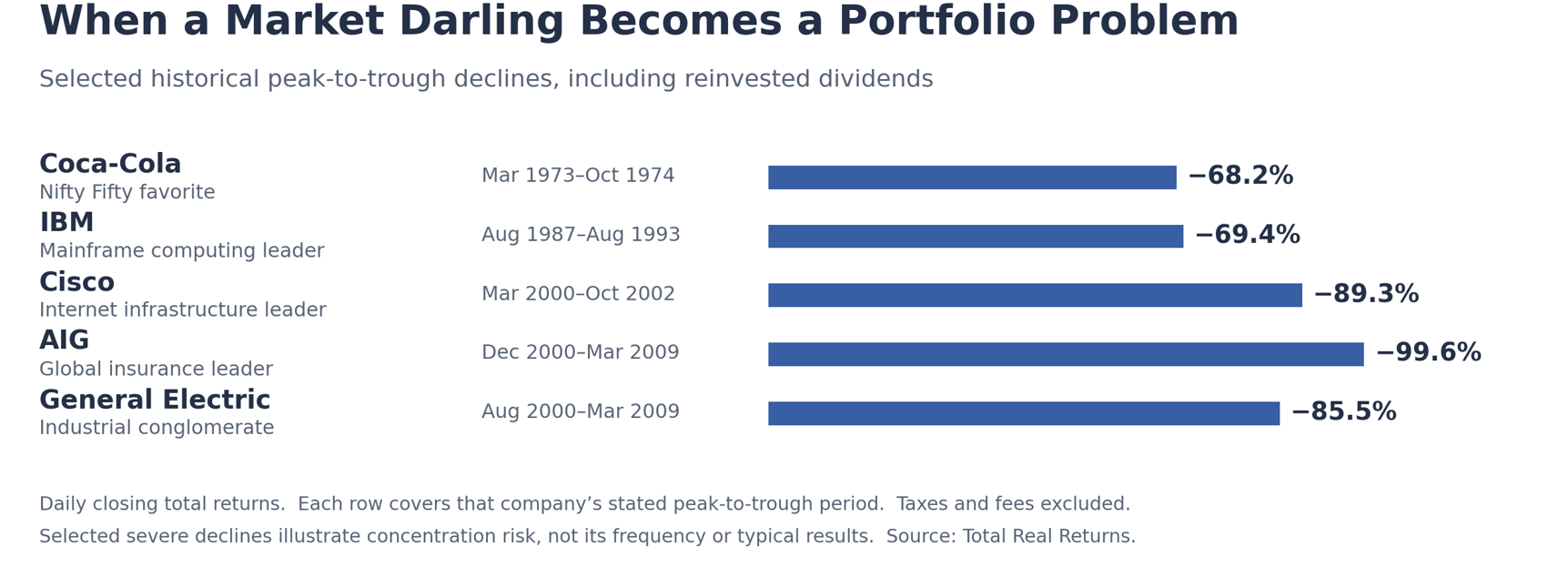
Coca-Cola, Cisco, and GE eventually regained their prior peaks on a total-return basis, with dividends reinvested, but the waits ranged from roughly a decade to more than 20 years. At present, AIG remains far below its 2000 peak. Recovery is possible, but neither its timing nor its occurrence is assured.2
Selling appreciated shares in a taxable account can generate capital gains taxes. The amount depends on factors including cost basis, holding period, income, and available capital losses.3 Those tax costs matter, but so does the financial impact of continuing to hold the position. Paying some tax may be an acceptable tradeoff for reducing a risk that could disrupt retirement or another important goal.
Start by reviewing the household’s full exposure, including shares held in different accounts and overlapping holdings inside funds.1 Vicus Capital can assist in this analysis. Then consider what a substantial decline would mean for spending needs and long-term plans. There is no single position size that is appropriate for every investor.
Reducing concentration does not have to mean selling everything at once. Options include scheduling partial sales, directing new contributions and dividends toward other investments, or using available capital losses to offset realized gains.3 A gradual approach may help manage taxes, although the remaining shares stay exposed to price declines. Employer trading restrictions may also affect timing.
One useful question is: If the client held their position’s value in cash today, how much would you recommend investing in that company? The answer can help separate attachment to an existing holding from the allocation that fits their needs now.
1 FINRA, Concentration Risk
2 Yahoo Finance: KO, IBM, CSCO, AIG, GE. Daily total returns with dividends reinvested; recovery status through October 29, 2026
3 IRS, Topic No. 409, Capital Gains and Losses
For Use with the General Public. Financial Planning and Advisory Services offered through Vicus Capital, Inc., a federally Registered Investment Advisor.


