

Election years can generate uncertainty for investors. Never ending coverage of campaign promises and shifting policy proposals lends to the idea that markets are highly sensitive to political outcomes. While that may be true in the short term, things like inflation, interest rates, corporate earnings, and consumer spending are all additional, powerful drivers of market performance. This year the excitement revolves around the U.S. midterms.
According to Ameriprise, market volatility is at its highest just before the election.1 Historical data shows that investors tend to react emotionally as election rhetoric intensifies, causing larger market swings during the months leading up to the vote. However, volatility has historically eased after elections as markets absorb the outcome and return their attention to broader economic trends. By reacting to the temporary volatility, your clients might miss out on the return to normal after results are in.
U.S. Bank conducted an analysis of 125 years of market data, which found that the S&P 500 has a habit of producing weaker-than-average results in the 12 months leading up to a midterm election, but stronger-than-average returns in the year after an election. While the historical average returns are 8.9%2, the 12 months leading up to the election are typically around 2.9% and the 12 months following midterm elections delivered gains of about 12.4%. Clearly this doesn’t always occur, as the S&P 500 is up 12.25% year to date, setting it up to potentially break the observed trend. Still, it is something to consider.
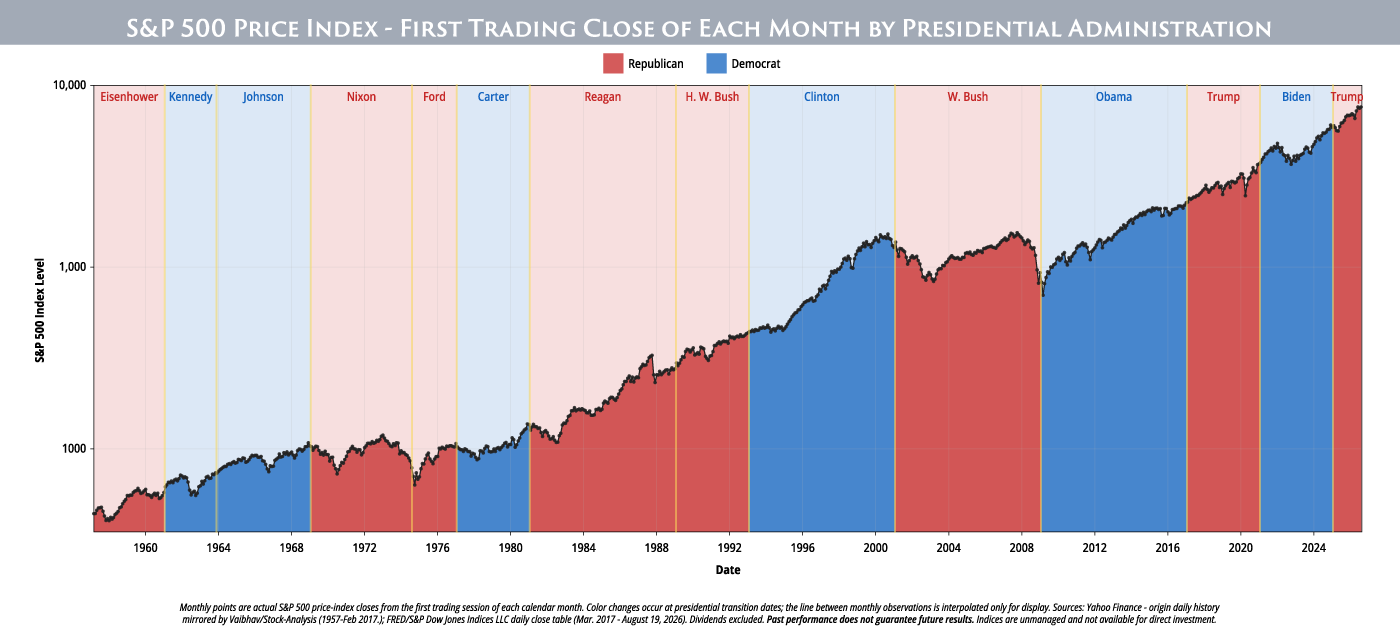
This doesn’t just apply to midterm congressional elections either. The chart above demonstrates that even though different parties gain and lose control of the White House, the S&P 500 continues an upward trajectory over time; despite short-term ups and downs. Overall, the S&P 500 has netted gains of 72% over the last five years, despite some significant contrasts in White House occupancy.3
Political policy, such as tariffs and geopolitical tensions, can certainly have an influence on the economy, but they are just part of the equation. Factors like company earnings reports, government spending, commodity prices, consumer behavior and decisions by the Federal Reserve all have strong influence over markets and the underlying economy as well.
Ultimately, election years tend to create more short-term noise than lasting market disruption. While policy changes can affect specific sectors such as healthcare, energy, defense, and financial services, the overall stock market continues to be driven primarily by economic fundamentals. While watching the market edge up and down can be nerve wracking, it’s important to maintain perspective. By keeping the focus on long-term financial goals and maintaining diversification, you can help your clients look past the political news cycle and stay on track with their wealth plan.
For Use with the General Public. Financial Planning and Advisory Services offered through Vicus Capital, Inc., a federally Registered Investment Advisor.


